Black Ducks in the Sunshine
One of six prints from A Field & Stream Portfolio. Six Paintings of Waterfowl by Peter Scott C.B.E. Published in 1953 by Henry Holt & Company Inc.
Click Here For Details Of The Complete Portfolio
Black Ducks in the Sunshine
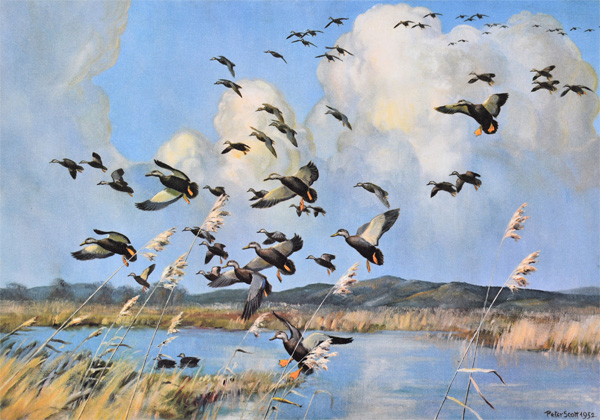
Unless you are Peter Scott, the painter, and live on a game preserve, you will seldom see this many, this close. Because this is a picture of black mallards coming in to a pool on a winter's afternoon, the late sun flashing off their wings. The way we see the black duck is generally pretty sketchy. Either he and his lady are traveling high, sneering at decoys, or he is jumping up ahead of you around the corner of a stream, and all you hear is whish and all you see is flash.
You know this boy, of course, the somber lad in the dark feathers, with the fleck of color on his wings, the yellow-green bill and red-or-yellow feet, who is not nearly so flashy as his ornamental cousin, the mallard, but who makes up for it in shrewdness. He is the spooky one, the high-traveling one.
The black is more reluctant to decoy than other ducks, but you can jump-shoot him pretty good, by working inland ponds and streams, because he likes his fresh water, and you can sneak around bends and take a whack at him as he whistles through the bush.
Let's face it, the black duck is not the most beautiful of all wildfowl. But on occasion, when the sun picks up the flash of creamy white under the wings and the bright orange legs and feet of an adult drake, he can look handsome enough, and whatever his appearance he can be as exciting as any because of his wildness and wariness. But just as black ducks are quick to learn the dangers of a duck's life where hunters are about, they are also quick to learn where they are safe. On the lakes in Central Park in New York, and in many other city parks in the Eastern States, they have become comparatively tame, and air travelers landing at Washington, D. C, are amazed by the way in which large flocks of blacks, clustered on the shore of the Potomac at the end of the runway, allow the huge plane to roar over them within a hundred feet without so much as taking their heads from under their wings.
For a long time there has been controversy over the existence of more than one kind of black duck - apart from the group of four sedentary local races which occur in the south (the Florida duck, the Louisiana mottled duck, the New Mexican duck and the Mexican duck). Some still assert that the more northerly breeding part of the population should be separated as the red-legged black duck. But it seems that most of the distinctions can be explained by differences between birds of different ages, and that they all really belong to one race. To the hunter it doesn't make any difference. Wherever you find him he flies fast and smooth and warily.
The picture shows a reed-fringed pool among the hills where many blacks accumulate in winter. It is a windy day of tall cumulus clouds; there is a flurry of wings flashing white in the sun as the birds come pouring in.
Description of 'Black Ducks in the Sunshine' from notes accompanying the ‘Field & Stream’ Portfolio of Six Prints of Waterfowl Paintings by Peter Scott.