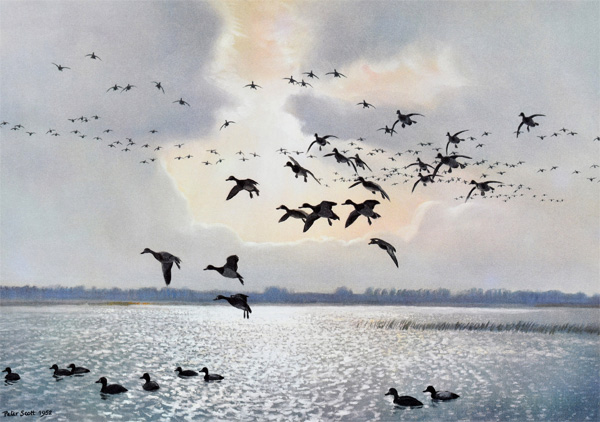
Broadbills Coming In To Raft
One of six prints from A Field & Stream Portfolio. Six Paintings of Waterfowl by Peter Scott C.B.E. Published in 1953 by Henry Holt & Company Inc.
Click Here For Details Of The Complete Portfolio
Broadbills Coming In To Raft
You can call a broadbill nearly anything from bluebill to blackjack to scaup. He's a nice, convenient little fellow, and sort of stupid in a sneaky way. There are always a lot of him around, and in huge rafts. He's a real dumb duck, but shifty in his dumbness.
You actually cannot prevent him from decoying if decoying is what he has in mind. He will come, a huge flock of him, and sidle into your front yard, doing aerial cavalry maneuvers at a low altitude, and all of a sudden there will be a whole raft of him squatting on the water.
One of several things is responsible for his salvation. Maybe it's the fact that he usually skims in so low that hunters overshoot him. Another is that he comes in without fanfare. He whooshes in. And as often whooshes away. Another is that he's little, and a lot of people, in mallard, pintail, redhead, canvasback country, won't waste their precious limit on him, although he eats well enough. No matter what the reasons, he persists and multiplies and can generally be counted on to provide sport and amusement.
You can see broadbills everywhere, in tremendous rafts, sometimes numbering up to ten thousand or more. Artist Peter Scott says he's seen them in quantity in Canada, in Lapland, in Iceland. You will find them breeding in the far northwest and wintering on both Pacific and Atlantic coasts. There is a greater scaup for Europe as well as a greater scaup for China. We divide ours into two - greater and lesser, or big and little.
For anyone interested in ducks, these are all romantic and exciting places, but perhaps the most impressive is the great volcanic lake of Myvatn in northeast Iceland, where the scaup is the most numerous of some fourteen species of breeding ducks. There is no more beautiful sight than the spring courtship of all these ducks on the blue waters of the lake, with the multitudinous islands aflame with golden kingcups and the snow-capped volcanos beyond. He's a dependable little fellow, the broadbill, and he will fly when the others won't, and he will come cosily to the blind, and even if he isn't coming, he will make you think he is going to come, which keeps you awake.
Peter Scott remembers him another way, and well. Artist Scott says: "The water in my picture is fresh water - a lake on a windy afternoon. The broadbills here have been disturbed at the other end of it; some have already settled, perhaps induced by decoys. If they are allowed, the whole flock will sweep around to head into the southerly wind with feet brought stiffly down as air brakes to settle in an ever-thickening mass. Those which cannot make it the first time will circle a second, even a third time, until the whole raft is clustered again tightly at this end of the lake and the birds are peacefully riding the ripples, with bills tucked behind scapulars, in the afternoon sunlight."
Description of 'Broadbills Coming In To Raft' from notes accompanying the ‘Field & Stream’ Portfolio of Six Prints of Waterfowl Paintings by Peter Scott.