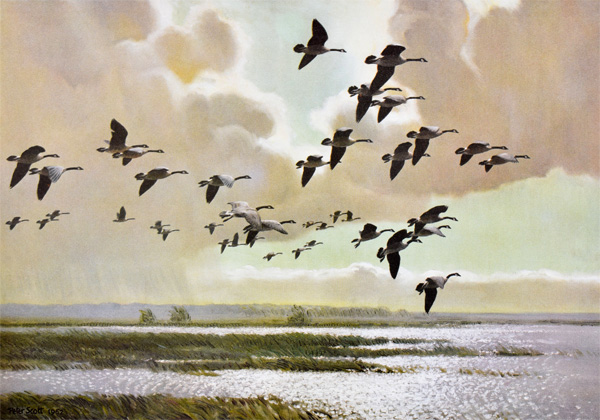
Canada Geese After a Squall
One of six prints from A Field & Stream Portfolio. Six Paintings of Waterfowl by Peter Scott C.B.E. Published in 1953 by Henry Holt & Company Inc.
Click Here For Details Of The Complete Portfolio
Canada Geese After a Squall
What can a man say about geese that is not already known by every other man who has heard the honking in the night, seen the great wings outspanned against the gray spring skies, heard the whistle of those wings and seen the fleeting spots against the moon? Somewhere, the goose has made immortality possible for himself. "Silly as a goose" is a gross canard, for the goose has captured the romantic imagination of man.
He is, somehow, man in flight - a seasonal change, a mournful happiness, a symbol of impermanence. His klaxon call is more exciting in the lonely night than a thousand trumpets. His orderly, V-shaped progress across the skies packs an impact that a fleet of a thousand bombers fails to deliver.
The Canada goose is not the largest of all geese, as so many think, because there is an African spurwing that will touch thirty pounds, whereas the old Canuck is very big at fifteen, and big enough at ten or twelve, But if he is not the largest, he is the largest that we are likely to see in great concentrations, and in great concentrations we will always see him. He is a fellow of regular habit and great intelligence. He goes north in the spring, and south in the fall. He is what the poets call a harbinger of the seasons.
Away up there in the sky, in that tremendous V, and the air full of gabble, he suddenly makes you want to cry for your lost youth, and to repent all the wicked things you've done, and rush right out to fall in love again. Shooting him is another matter.
There are all sorts of snide and illegal ways to shoot the honker, but to shoot him on the square, under existing game laws, is a tricky bit. He knows, somehow, the difference between 4 p.m. and 4:01 p.m. He has eyes better than a buzzard. He seems to smell pretty good, too, and the canny old boss gander is as smart as Bernard Baruch. When the Canuck is feeding on the ground, there is always a set of sentinels, acutely alert. To get him to blind may be mighty simple on one day, acutely impossible on another.
He is a cosmic character, this old gray bird from Canada. You can find him on the Gulf of Mexico, and in the arctic islands, and from the Atlantic to the Pacific. Twelve different races of the Canada goose have been separated by naturalists. You will see him from Utah to Scandinavia, from Great Britain to New Zealand.
Every man's hand is against the Canuck. He is so big, and so beautiful, and so transient, that Artist Peter Scott says that more than half of the northern flight are toting shot-pellets in their bodies. But still the old honkers flourish. Still they increase, because a Canada goose does not discourage easily.
Peter Scott's geese - including the one with the shot-torn wing at the left - have been disturbed by a squall from their feeding grounds, and are taking off for a wash and a gurgle in the open water.
Description of 'Canada Geese After a Squall' from notes accompanying the ‘Field & Stream’ Portfolio of Six Prints of Waterfowl Paintings by Peter Scott.