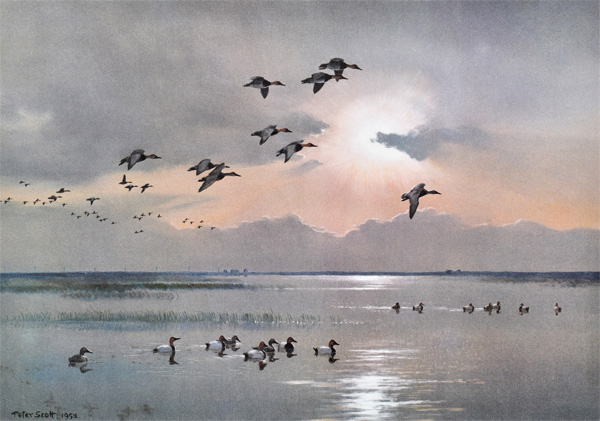
Canvasback on a Still Afternoon
One of six prints from A Field & Stream Portfolio. Six Paintings of Waterfowl by Peter Scott C.B.E. Published in 1953 by Henry Holt & Company Inc.
Click Here For Details Of The Complete Portfolio
Canvasback on a Still Afternoon
There was a time when this duck was a symbol of Lucullian living. The Baltimore blood of the early century dined simply. They opened with oysters and middled with terrapin and closed with canvasback, spreading a lot of champagne around the area. The canvasback became the caviar of America - and in the process was nearly eliminated.
He was killed for the market and shipped all over the country, where the rich and mellow politicians dined off terrapin after the oysters, and dipped their dollar seegars in vintage brandy. On the Susquehanna flats in Maryland, a habitat the big, succulent fellow adores, they slaughtered him for market by the millions.
They used to hunt him with punt guns - bloody great blunderbusses mounted on the prow of a big, shallow-draft skiff, and loaded with everything from nails to rocks. They would hunt him in the winter, after the ice had come, to leave only shallow pools where thousands of the cans would congregate in a small area. One blast, and hundreds of ducks lay stone-cold dead for the market. A few years ago, you could buy a brace of canvasback for two bits.
But under conservation, the big, thickly meated, red-headed whiteback has staged a grand comeback, and once again pocks the waters of the Susquehanna by the thousands. He's around Long Island Sound, too, and is breeding lustily west of the Great Lakes.
The lineage of the canvasback is a touch clouded, like most American lineages. Seems likely that he and his cousin, the redhead, are melting-pot products of a common ancestor who also sired the European pochard. Painter Peter Scott suggests that the redhead and the canvasback are the results of two separate colonizations in America, with the reds coming across the Atlantic from Europe and the cans coming in from Asia across the Pacific.
The only knock on the canvasback is that he is not a purist in his diet. He is not a fish duck, but he will eat fish if there's a shortage of other chow, and if he eats enough he will taste like a merganser. This is a chance you lovingly take. On a correct diet he has no superior, unless it is the pintail, in the big-duck department.
There are not enough of the canvasback around, still, to make him totally secure, but he's on the increase, and may be shot with fair certainty. He spells nobility in the sky as well as on the palate, and he bespeaks a certain way of life we once had when the tax on Bourbon whisky was low and capitalists dined in cliques.
Artist Scott has not striven to catch the dinner-table aspect of the can. What he has sought is late-afternoon beauty, painted in thin, almost water-colory oils. What he was after was serenity, with the water ruffling silver in the late day, the ducks unafraid of the gourmet as they come home to sleep, and perhaps a hint, a shimmer, of thunder in the air above the marsh.
Description of 'Canvasback on a Still Afternoon' from notes accompanying the ‘Field & Stream’ Portfolio of Six Prints of Waterfowl Paintings by Peter Scott.