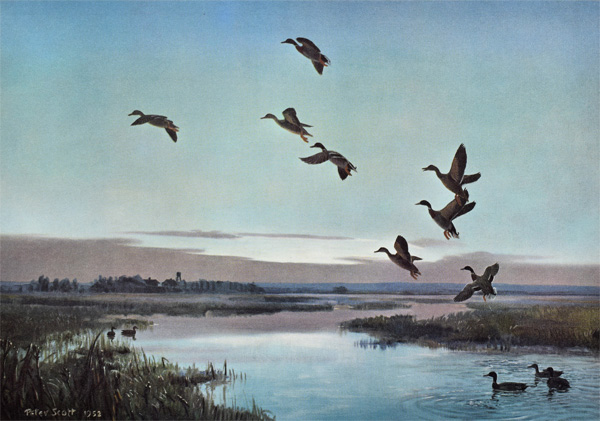
Mallards Jumping
One of six prints from A Field & Stream Portfolio. Six Paintings of Waterfowl by Peter Scott C.B.E. Published in 1953 by Henry Holt & Company Inc.
Click Here For Details Of The Complete Portfolio
Mallards Jumping
A mallard is an easy duck to describe. The Cajuns in Louisiana call him a French duck. Mostly the drake is called a greenhead. Some call him a puddle duck. He's scattered, in several gradations of species, all over the world.
The mallard is the big duck - the zoot-suit duck, Chicago style. Those big yellow shoes and that big yellow bill and all that tweed and herringbone vest and purple-green haberdashery make him a little vulgar, but awful important. Wherever you find him, he is a fancy gentleman, a dude. And like all fancy gentlemen who are dudes, he will leave you in a hurry. Generally, with the check unpaid.
Actually, the mallard is a little bit of a fraud, because he'll eat some fish on you when you're not looking, and despite his fine clothes he'll come out tasting awful. But he makes up for it in sheer drama, like a good ham actor. For he's as big as a goose, nearly, and he can come in as fast and take off as fast as a teal. Maybe not quite so fast, but it is a good bet that more people will miss he-mallards in a hurry than will miss teal.
Absolutely the most wonderful thing about the mallard is that despite his fondness for the puddle, his family is inflicted with wanderlust. You can find at least some of his cousins in nearly any place in the world that has water. The range of the mallard is vast and covers most of the lands of the Northern Hemisphere. It is as widespread in Europe and Asia as it is in North America, though there are probably no other concentrations of mallards to compare with those of the Mississippi flyway. The mallards of Greenland are apparently non-migratory and have evolved into a recognizable subspecies, Anas platyrhynchos conboschas, the Greenland mallard. It may be that the mallards of Europe and Asia will ultimately prove to be recognizably different from those of North America, though none has succeeded in showing this so far.
Peter Scott has caught a good piece of the mallard spirit here. Peter calls it "Mallards Jumping." That is what a mallard does. He does not take off like a plane. He does not leave neatly. He jumps, as if he had just been goosed. You should pardon that expression when talking of the mallard.
The best advice on mallard shooting was contributed by a Cajun guide in Louisiana. He said: "When the beeg French duck hees come down, shoot hees tail. When hees go up, shoot hees nose. When hees go past, pray. When hees go away, don' shoot."
The main thing about a mallard is that when you have got him in the boat, you have got yourself a duck. You have not shot a pigeon, or a water-turkey, or a coot. A mallard is the waterfowl equivalent of a lion. Even if you can't eat him - if he's cheated and gorged himself on fish - he makes you feel important for that day.
Description of 'Mallards Jumping' from notes accompanying the ‘Field & Stream’ Portfolio of Six Prints of Waterfowl Paintings by Peter Scott.