A Biography of Peter Scott by Hunter and Wildfowler, Robert Chester Ruark Jr.
The foreword to the 'Field & Stream' Portfolio of Six Paintings of Waterfowl by Peter Scott C.B.E.
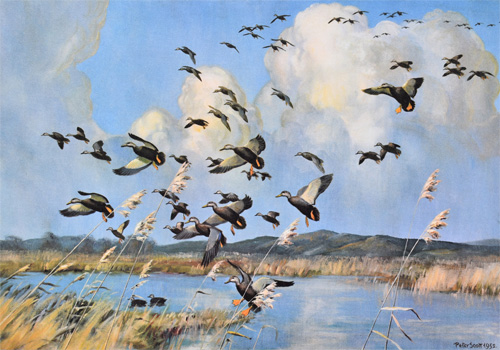
I am not a painter, but I am a duck hunter, and I know how a duck is supposed to look. One of the ways a duck is not supposed to look is like a stuffed duck, which is how so many artists make a duck look. A duck is really a fairly awkward bird if you will think back to all the ducks you have seen. He lands badly and takes off clumsily. His even flight, once he's got his altitude, is a creaky-winged, stiff-flapping progress. When he is in the air, he does not look like the duck you see in old dining-room paintings of dead birds. He looks like an impression of a duck, which is actually what he is, away up there, or scudding in low, or zooming high, or darting, or flapping, or whatever it is the duck is doing.
Field & Stream is very proud to present this portfolio of wildfowl studies by an artist who has had more success in making ducks look like real ducks, and geese like real geese, than any other living man. His name is Peter Scott, and he is an Englishman whose prime passion, for some years now, has been the investigation of ducks and geese and the imprisonment of same on canvas. When you look at the first study - that of mallards jumping - you automatically feel for a duck stamp and curse yourself for underleading the drake.
Of course, Scott started out as a shooter, because it takes a shooter to appreciate the quarry. He says himself that he was first inspired to paint waterfowl in much the same manner that a caveman painted a hairy mammoth or a saber-toothed tiger on his cave wall, as trophies. He admits he shot ruthlessly, and it finally palled on him. A man can tire of a sport if he becomes automatic in it.
He was living on a salt marsh on the east coast of England prior to the old war, the one we call Two, and started to paint the thousands of waterfowl which flighted in. The war halted the effort - Scott was five years in the navy, and collected a gong or so for his work with the small and dangerous boats. From the war, which may have made him a little sicker of killing, he came back to the same place, where the birds he loves congregate. It is now called the Severn Wildfowl Trust, of which the new Queen of England is a patron, and it is located at Slimbridge, in Gloucestershire, about three auto hours out of London. Slimbridge's boss is Peter Scott, who has some rather interesting heritages going for him. His father was the arctic explorer, Sir Robert Falcon Scott, and his mother was a famous sculptress. Peter has painted since he was a kid and wandered around nearly as much as his father, although in somewhat more clement climes.
The wandering is pretty important to Scott the painter, as well as to Scott the shooter, and to Scott the naturalist. Just say, for instance, that his experience has not been confined to the Continent, but that he knows our North American waterfowl and their habitat as well as he knows the honkers and quackers that visit him on the Severn in England. He has pretty well blanketed Europe, Asia and America in his quest for knowledge in the duck department.
Thing about Scott is that he literally paints his birds out of the blind. His house is in the middle of the sanctuary. Most days he can see 5,000 ducks and geese and swans. A lot of transient ducks, supposed to go tearing off to another continent, like it so well around Scott's place that they call off the travel urge and just stay there. In what he calls his "collection" - about 1,000 waterfowl from all over the world - a great many don't have their wings clipped. They're free to take off if they want. They don't want.
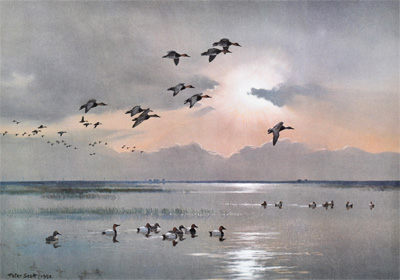
So Peter Scott stands at a ten-foot-wide window, looking out at more unusual waterfowl than you and I will ever see: Ross's geese from Canada; red-breasted geese from Siberia, with or without an exit visa; Orinoco geese from South America; bar-heads from India; and especially the rarest of the rare, the Ne-Ne geese from Hawaii, of which there are probably no more than forty living in the world today. I suppose they like the service at Scott's place.
Peter Scott is a fast painter. He doesn't use photographs for models except rarely, but stands by his window painting the impression of the ducks and geese in flight. He paints like most of us shoot - getting what he sees as it passes - which accounts for the magnificent speed of his paintings. As a matter of fact, he doesn't have a palette. Paints off the top of an old chest of drawers, using the top for his colors and the drawers for his brushes. Paints mostly out of his head, only occasionally doing a pencil sketch or so in advance.
When he's not painting, Scott serves as director of the Trust, which rings and marks wildfowl with dyes. You might also be interested to know that modern science has finally been harnessed to work in a fairly harmless fashion. Scott traps his birds with a rocket gun that scatters a wide net over the quarry in such an amiable fashion that some untrapped geese fly only four hundred yards away from the trapped ones. And when the trapped ones are released, they join the untrapped ones. Scott marks his subjects with a harmless dye, which evidently is unobjectionable to the undyed birds. He collected one such dyed bird in Iceland, a pink-footed goose.
There is not a very great deal to say about Scott, once you've seen his paintings. We lead off with his jumping mallards, and you are bound to say that Scott does not paint chromos - he paints mallards on the leap.
From Robert C. Ruark's introduction to the 'Field & Stream' Portfolio of Six Paintings of Waterfowl by Peter Scott C.B.E., published in 1953.